/


Oriens Extremus 62 is the first issue after we switched to a two-year rhythm. It contains an extensive special section on "exploring revenge across Chinese history", guest-edited by Markus Haselbeck and featuring articles by Michael Nylan, Wen Ruoxuan, Marco Pouget, Joachim Gentz, Zhang Rui, Raffaela Rettinger, Alison Bailey, Woohui Park, and Zhang Huiwen. In the general section, Sebastian Veg presents a brief history of the concept of the intellectual in modern China. Furthermore, we continue our series of academic translations from China with "What Is Love? The Modern 'Moment of Globalization' of the Chinese Concept of Bo’ai 博爱“, written by Chu Lijian and translated by Carissa Fletcher.
Welcome to the new Oriens Extremus website.
Founded in 1954, Oriens Extremus has continuously been devoted to outstanding research dealing with East Asian cultural and intellectual history. In 2013, it launched a new series with a sharpened profile, designed to open up new prospects in East Asian studies and to promote the exchange with scholars from neighboring disciplines. More…
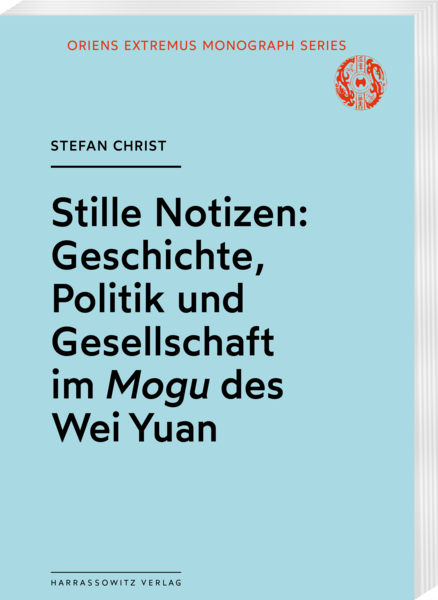
Wei Yuan 魏源 (1794–1857) is commonly regarded as a pivotal thinker of an early "Enlightenment" at the threshold of Chinese modernity. Yet, the precise definition and parameters of his "modernity" remain elusive. This is due in no small part to the fact that one of his most vital texts, titled Mogu 默觚, has never been thoroughly analysed. With Stille Notizen, Stefan Christ presents the first complete translation of this important source. Simultaneously, he critically interrogates the nature of Wei Yuan's modernity and the potential for enlightenment in early 19th-century China. He constructs a compelling portrait of a figure suspended between eras: Wei Yuan acutely perceives the fractures in the old order while simultaneously seeking refuge within it. He observes a changing and complex world that can no longer be traced back to a single unifying principle, yet turns to Confucian tradition to safeguard the state's central authority. He rigorously analyses the internal logic of politics and economics, but stops short of forging an entirely new conceptual vocabulary.